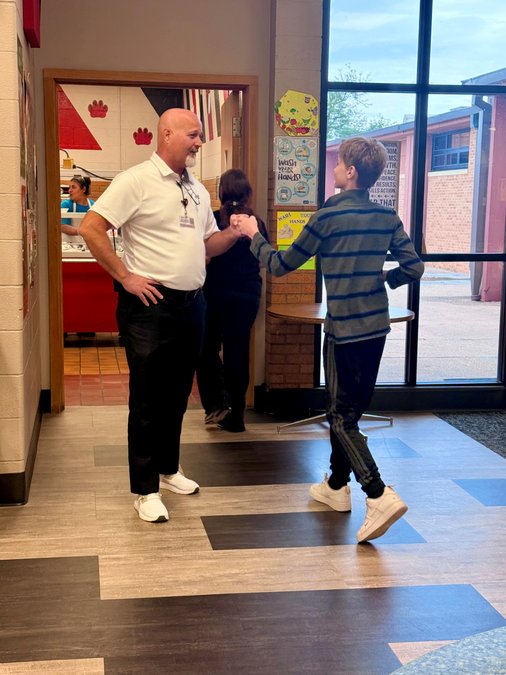
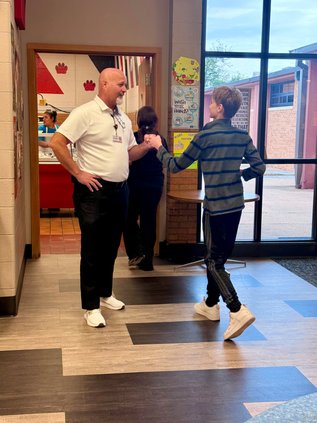
Middle school is a time of constant change. Friendships shift, expectations grow and students are trying to figure out who they are, often while navigating an entirely new school environment.
For Great Bend Middle School Principal Myron Ellegood, helping students through those challenging years requires much more than textbooks, test scores and classroom instruction.
It takes patience, flexibility and, perhaps most importantly, adults who genuinely care.
“Middle school is difficult — it’s very difficult,” Ellegood said. “Teenagers can be rough and hard on each other and just going through that maturity process, learning how to deal with conflict — it’s always difficult.”
But Ellegood also believes something fundamental about students hasn't changed, even as the challenges facing schools and families have grown.
“Ultimately I think all students still care — they still want to do their best — they still want to please adults,” he said. “They’re just looking for someone to be a mentor to them.”
Ellegood's path into education was influenced by both family and the teachers and coaches who made a difference in his own life. Both of his parents were educators, his brother is a principal in Buhler and his sister teaches in Hays.
“Outside of that it was mentors, teachers and coaches,” he said. “I wanted to coach and teach.”
He began his career doing just that, teaching physical education and strength and conditioning while coaching football and wrestling. Becoming a principal wasn't part of the plan but competition runs deep in his family.
“I didn’t initially see myself as a principal but I’ve kind of been driven by competition with my brother being a principal,” Ellegood said.
After serving as assistant principal and athletic director at Great Bend Middle School, Ellegood became principal in 2023. He has spent approximately 13 years in the building.
Outside of school, he understands the demands families face when juggling children's activities. With three children participating in sports at the middle school, high school and college levels, his family spends considerable time traveling.
He also maintains his family's agricultural roots, helping his mother farm land in Osborne County, where she grew up. Although he was raised in Garden City, weekends without sporting events frequently meant trips to the family farm.
One of Ellegood's greatest points of pride is the staff at Great Bend Middle School.
“They are a very special group of people — they have very giving hearts; they’re very helpful,” he said. “One of the things I’ve always heard from people visiting or substituting in the building is how helpful and welcoming our staff is.”
Curriculum changes, evolving programs and changing student needs require teachers to continually adapt, often while investing substantial time beyond the regular school day.
“It’s ever changing — education — and that’s difficult for a lot of people,” Ellegood said. “Our teachers are pouring in a lot of hours just to stay up with the curriculum. Trying to reach the students and provide the best education.”
The school's leadership team works to make employees feel supported and appreciated. School Improvement Teams focus on areas including school culture and staff recognition.
Ellegood also recognizes the importance of giving employees opportunities to attend their own children's activities.
“We try to do our best to accommodate when a staff member has a child in an event — we try to cover for them or give them time off as needed,” he said. “We want them to have a life outside of education.”
Recruiting teachers remains another challenge, particularly in western Kansas.
Ellegood said the district has been relatively successful in retaining staff, but attracting new teachers has become increasingly difficult. Science and math positions can be particularly challenging to fill.
“When I first started teaching, our principal would say he would have a stack of 15-20 applications,” he said. “Now we’re lucky to get 2-3.”
Although applicant pools have shrunk, he said the school has been fortunate to find qualified candidates, sometimes filling positions with instructional support personnel.
Another challenge Ellegood and his staff face is the bringing together of students from five public elementary schools and two private schools.
For many, the transition means leaving a familiar classroom and teacher behind and adjusting to multiple teachers, changing classes and a much larger group of peers. Sometimes, Ellegood said, that adjustment can affect academic performance. He noted that schools often see a decline in performance between sixth and seventh grades, followed by stronger growth as students progress into eighth grade.
“We don’t know exactly why that is but transitions for students are difficult,” he said.
The amount of instructional time also changes. Elementary students generally receive approximately 90 minutes daily in math and reading, while middle school students typically have 46-minute classes unless they participate in additional academic support.
About three years ago, the Building Leadership Team implemented a policy requiring students who fail a class to make up the coursework through Edgenuity, an online learning program.
Ellegood said the policy has produced encouraging results.
“We’ve seen a dramatic drop in students failing,” he said. “So, it’s been very beneficial for us.”
Ellegood said the school is also examining scheduling changes that could increase instructional time in core subjects.
“One of the things I’m not sure the community is aware of is we offer before and after school tutoring,” he said of the individualized training offered both before and school, beginning at 7 a.m.
Although academics are a priority, Ellegood believes students also need opportunities to discover their interests and develop relationships outside the classroom. However, sometimes space is an issue.
Great Bend Middle School offers a variety of extracurricular opportunities, including art clubs, a gaming club, Fellowship of Christian Athletes, bowling club and athletics.
The school has four athletic seasons rather than three, giving students opportunities to experience a broader variety of sports.
“I think that’s nice because kids don’t always know what they want to do until they experience it,” he said.
The school also offers Jobs for America's Graduates, or JAG, a program Ellegood said has benefited students at both the middle school and high school.
The challenge isn't overcrowded classrooms but finding available space for the variety of programs the school offers.
However, Ellegood thinks those opportunities are particularly important as the circumstances students bring to school continue to change.
Ellegood said more students are receiving financial assistance, and challenges at home can create additional obstacles in the classroom.
“The family environment has changed a lot — it’s challenging for students at home but it also creates challenges at school for them,” he said.
He also recognizes the changing demographics of the district. Enrollment at the middle school is now slightly below 400, he said, compared with periods during his tenure when enrollment exceeded 500.
Despite the challenges, Ellegood believes the school has plenty to be proud of.
“We have a lot to celebrate but we also have a lot to work on,” he said.
And while test scores, enrollment figures and academic programs are important measures of a school's performance, Ellegood hopes the community recognizes something that cannot always be measured.
“Sometimes I don’t think our community realizes just how much our staff is invested in these students.”