The Great Bend Tribune has focused on severe weather awareness and preparedness throughout the month, and there are more stories on the topic today. Over the years, several tornadoes have had an impact on me. Thankfully, I was never in personal danger, although some tornadoes and windstorms have impacted relatives.
The June 8, 1966, tornado that hit Topeka roared so fiercely that people all over town thought it was directly over their homes.
I was 8 years old, so my memory of this event is fuzzy. We lived about 20 miles from Topeka in Lecompton, but we headed to a basement that evening. We were listening to weather reports, and the sky looked “funny.”
My dad was in Topeka, working at the Santa Fe Shops. Another woman posted on social media (Topeka History Geeks) that her father was also working at the Santa Fe shops. She said he rode it out under a train car that was rocking.
I don’t remember any tornado stories from my father, but I think we always took tornado watches seriously after that.
The Topeka tornado killed 17 people, injured over 500 and caused over $200 million in damage. According to the National Weather Service, at the time that was the highest tornado damage in American history. With inflation factored in, the tornado still ranks as one of the costliest on record.
The tornado formed about 7 p.m. west of Auburn in southwest Shawnee County and cut a 22-mile path, at times a half a mile wide, across the heart of the city. Total devastation occurred along an eight-block section in the center of Topeka. Every building on the Washburn University campus was either destroyed or heavily damaged, producing $10 million damage in just that area. Citywide, about 800 homes were completely destroyed with nearly 3,000 damaged. Even the state Capitol dome sustained damage from the flying debris, as did many downtown buildings. The intense destruction classified the tornado as an F5, the top of the Fujita Intensity Scale, with winds estimated at over 250 mph.
The NWS adds: Excellent watch, warning and storm spotter activation prior to the storm’s development helped keep the death and injury toll relatively low, especially when compared to the amount of destruction in the storm’s path. In addition, the existence of an active and long-standing community preparedness plan and underground sheltering options likely also proved instrumental in reducing potential casualties and injuries. Outstanding education, cooperation and understanding between Topeka governmental agencies, the media and public became a model for other cities to follow in the future.
Hoisington Tornado
I was living in Great Bend when the April 21, 2001, tornado hit Hoisington at 9:15 p.m.
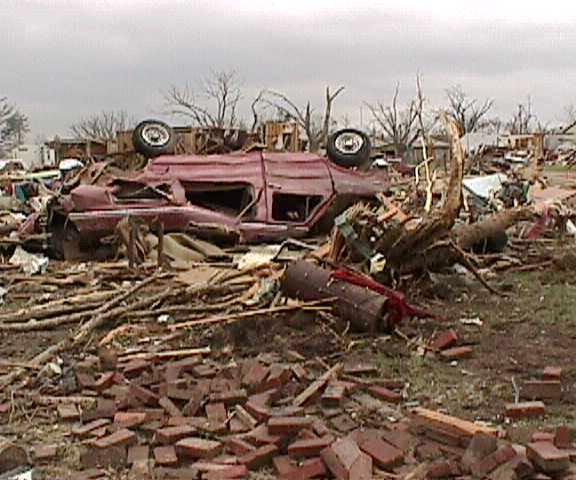
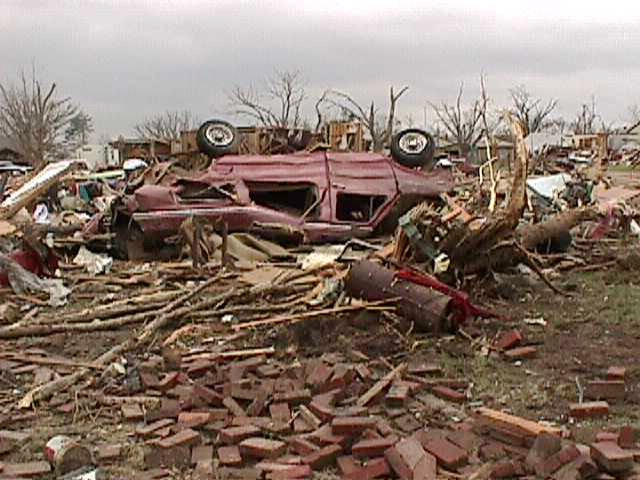
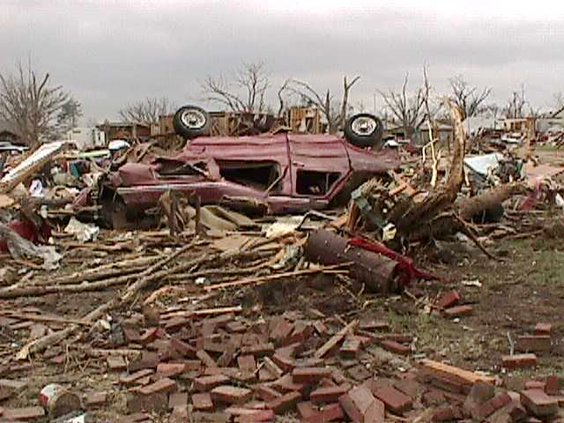
That tornado touched down in southwest Hoisington, on the edge of the city limits. The National Weather Service rated the tornado F4 on the Fujita scale. It moved northeast after hitting Hoisington for approximately two miles and was rated F2 after leaving Hoisington. The tornado then turned to the north/northeast. The total path length was approximately five miles and the path width was approximately 3/8 of a mile. Just before lifting, the tornado caused F0 to F1 damage. One fatality, Gerald Tauscher, was reported, along with 28 injuries (two critical). Two hundred homes and 12 businesses were destroyed and 85 homes were severely damaged. Two hundred more homes received minor to moderate damage.
The Great Bend Tribune later published a 64-page book, “Night of Destruction,” with details and photos. It noted, “Many businesses were damaged during the storm. This included losing the only grocery store in the community — the Town and Country Supermarket. In addition, the Dairy Queen, a motel, a pharmacy, and the bowling alley were completely destroyed. The twister also did extensive damage to Clara Barton Hospital and Hoisington High School.”
In the coming days, Hoisington filled with volunteers from all over Kansas and the United States, helping clean-up go quicker. The residents of this community began to look forward to building a better Hoisington.
Other tornadoes that come to mind are the 2013 EF-5 tornado in Moore, Oklahoma, the 2022 EF-3 tornado in Andover, the 1999 F-4 tornado in Haysville, and the 2007 EF-5 tornado in Greenburg.
We’ve had our share of shifting weather patterns this month, which is why spring is always an excellent time to prepare for severe weather and to stay aware of weather conditions.
Susan Thacker is managing editor of the Great Bend Tribune. Contact her at sthacker@gbtribune.com.