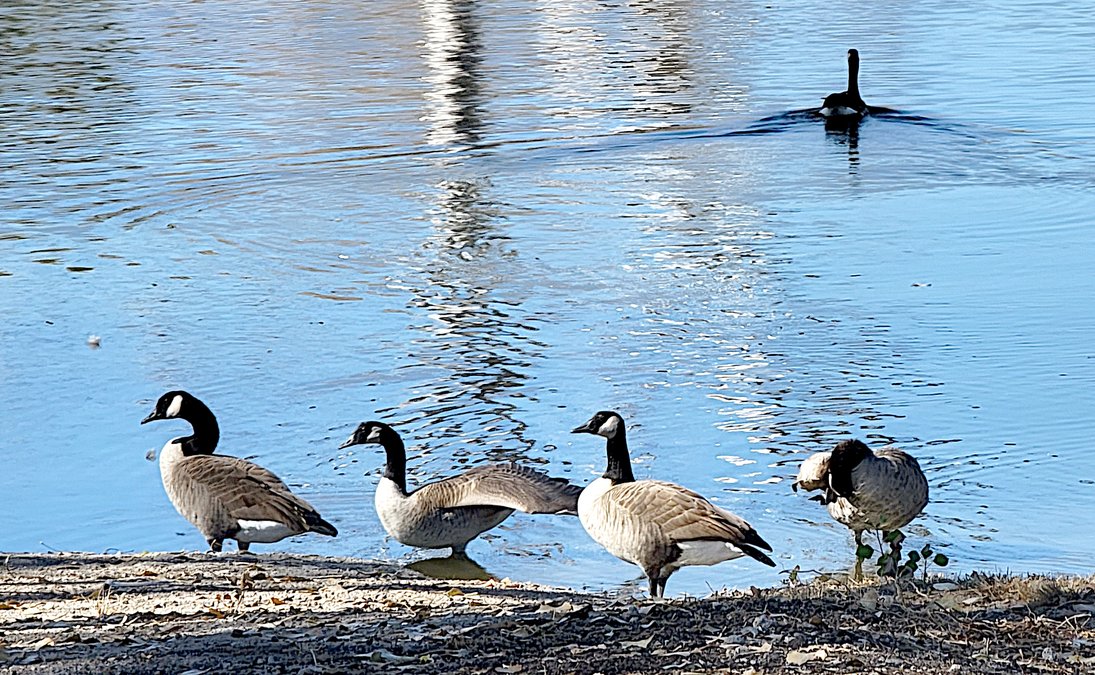

The birds are back in force as flocks of Canada geese find Great Bend’s Veterans Memorial Lake an appealing place to plop down for a spell as they head south for the winter. However, they are messy guests, Public Lands Director Scott Keeler told the City Council Monday night.
“As you all know, it’s a time of year where we’re getting the migratory birds that are coming in pretty hot and heavy,” Keeler said. With low water levels at Cheyenne Bottoms this year, “we are definitely seeing an influx of the Canada geese coming in.”
So, starting Tuesday, his staff was going to war.
“We are planning on starting our annual campaign and trying to scare the geese and minimize the numbers out there. We just need to get them to go out in the fields or back out to the Bottoms so they aren’t leaving all the waste in our pond.”
What does this involve? Making a lot of noise.
“We have noisemakers,” he said. In the spring of 2014, the city purchased two, hand-held pistol-like launchers that will be used to shoot “bird bombs” and “screamers” 80 feet into the air over the lake.
“We usually have to do that two or three times a day,” he said. “And it only takes a couple times to get the migratory birds to fly out.”
But, they have to keep up the pressure.
“This time of year, you have flocks coming in on a weekly, sometimes daily, basis,” he said. That means the battle will continue as they “try to minimize the numbers out there.”
Why is this a problem?
From 2010 through 2015, the lake was plagued by toxic blue-green algae plumes, forcing the Kansas Department of Health and Environment to place it on its warning and watch lists. During that time, the KDHE encouraged people and pets to avoid prolonged contact with the water, and eventually caused a massive fish kill in the summer of 2014.
The phosphorus-laden waste from geese that landed on the lake was a key contributor to the toxic blue-green algae problem. Officials also addressed the amount of phosphorus entering the lake through storm water runoff which occurs primarily from lawn and crop fertilizers, and the washing of grass clippings and leaves into storm drains, etc.
Also in the spring of 2014, the council approved contracting with a consulting firm, CH2M Hill, of Englewood, Colo., to help remediate the algae problem.


