George N. Moses in Kansas history
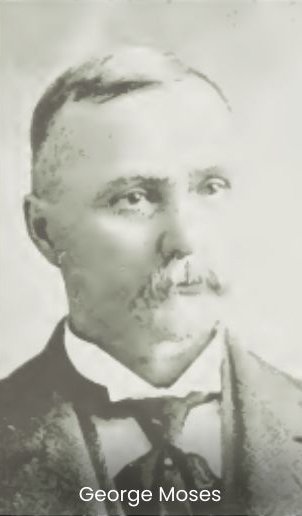
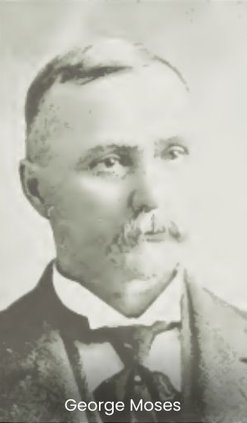
George N. Moses served as the first sheriff of Barton County, from 1871 to 1875, when the cattle trade was on there, and he was one of the best known peace officers in the West.
In the passing of George N. Moses, Sept. 10, 1911, Great Bend lost one of its best known pioneers and most influential citizens. Mr. Moses came to Barton County in the early 1870s, prior to its organization as a county, and for over forty years was an active worker in promoting the upbuilding and improvement of the county and its county seat, Great Bend. His career was replete with the deeds of a full, useful, honorable life, and he passed away rich in the esteem of his fellowmen. ...
George N. Moses was a student in the public schools until seventeen years of age, and in 1861, with youthful ardor and patriotism, he enlisted in Company I, Fifteenth Illinois infantry, to support the cause of the Union in the great conflict then just opening. He was in active service until wounded, near Memphis, Tenn., at which time the forefinger of his right hand was shot away. Disabled at that time for further military service, he was discharged, but in 1864 reenlisted and became first sergeant of his company, serving with that rank until the close of the war. He served as a member of the police force, at Sedalia, Mo., for a time after the war, and also served as a United States marshal in New Mexico and Arizona.
Later, he was a miner in Colorado and a scout and Indian fighter in Kansas. He marked the Texas cattle trail to Great Bend, when Abilene was abandoned, and it remained there four years before it was changed to Dodge City. He traversed every part of southwestern Kansas, while scouting and hunting buffaloes, which then were still very numerous, and it was while thus engaged that he became acquainted, at Saline, Kan., with Luther Morris, of Quincy, Ill., well known as a promoter and builder of towns. Acting as a guide, Mr. Moses accompanied Mr. Morris, and together they arrived on the site of what is now the city of Great Bend. They located on Walnut Creek, near a spring, and established a town site on section 34. Mr. Moses secured a quarter section of land, where the town is now located, and built a foundation for a building, but later a combination of the railroad and land site companies was made, and as the new company considered the quarter-section held by Mr. Moses to be the most desirable for the new town site, he disposed of his land to the company and took another quarter-section farther west. The Quincy Townsite Company had erected, on the original quarter-section purchased from Mr. Moses, first a shed built by Lewis Fry, and then followed other buildings, including a hotel, a store, and a dance hall. Among the first settlers were Mr. O’Dell, P. Sneck and F. L. Stone, the last named having been proprietor of the first store, which occupied a part of the new hotel. This was the beginning of what is now the thriving and progressive city of Great Bend. From the time of his arrival in Barton County until his death, Mr. Moses was actively identified in different ways with the development of the county and its industries.
Source: Pages 107-109 from volume III, part 1 of “Kansas: a cyclopedia of state history, embracing events, institutions, counties, cities, town, prominent persons, etc.” Edited for length. Read the full account online at https://www.ksgenweb.org/archives/1912/m3/moses_george_n.html
Sheriff Brian Bellendir wants to bring the model 1860 Colt revolver owned by Great Bend’s first sheriff, George N. Moses, back to Barton County.
At Tuesday’s Barton County Commission meeting, Bellendir said he has located gun and is working to secure it. The effort will require raising around $10,000 and the sheriff stressed that no taxpayer money will be involved. He does hope it can eventually be displayed at the Barton County Courthouse.
The gun sat in a shed in Dodge City for 17 years and is now in New Jersey, Bellendir said. One thing that makes it valuable is the authentication.
“The provenance on it is excellent. There is no doubt that that was his gun,” Bellendir said.
The gun, a cap and ball revolver, has not been converted. It was issued during the Civil War, when Moses was a veteran fighting for the Union.
“It is my goal to get that gun back here to Barton County. We’re not going to use tax dollars to do it, but I’m going to be out begging and soliciting funds. This is a piece of local history that needs to come back here.”
Bellendir said he is in negotiations to secure the gun. At one point, he had hoped it would be donated to the county. He does not know what the final price will be.
His original thought was to add the gun to a display at the Sheriff’s Office with a couple of other sheriffs’ guns. The collection has grown to become a small museum, of sorts.
“When I retire, I’m probably going to donate my gun also. But I think Sheriff Moses’ weapon, if it were here in the courthouse, would be exposed for more people. I would like to see it displayed on the first-floor foyer here.”
“But, like I say, I gotta get the gun bought first, and there will be no tax dollars used to buy the weapon. We’re either going to do it from non-tax money or through private donations. I’m open to suggestions on how to raise the money. I’ve been dealing with this for about a year.”
Bellendir noted that Moses was remembered as an honorable man at a time when some lawmen were “on the edge.” There is quite a bit of history, so Bellendir hopes he will be able to find a photo of Moses holding the gun.
Commissioner Donna Zimmerman said Bellendir’s plan could be combined with something she has been working on. She’s been working with county administrators to get the original doors to the courthouse. She hopes to obtain at least two of the four doors, “so we could build a kind of a shadow box somewhere on the first floor,” where items could be displayed.