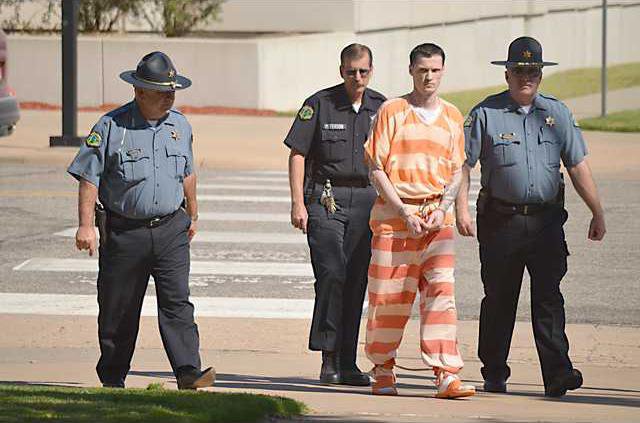
For two weeks, convicted murder Jeffrey Wade Chapman was seen being escorted to and from the Barton County Courthouse in street clothes and no apparent restraints, nothing preventing him from making a run for it.
“We received several calls from folks asking why that guy wasn’t chained up,” said Barton County Sheriff Brian Bellendir. What the public wasn’t aware of was that there was very little chance of Chapman getting away.
The fact that people were calling about this means Bellendir’s methods were working.
Under those clothes were two devices keeping the prisoner in line. The first was a four- or five-inch-wide stun belt with metal contacts worn just above his waist and under his shirt. With the push of a remote control button by an officer, a four-second, 50,000-volt charge would have gone coursing through his body.
“It’s like a Taser,” Bellendir said. “It would have incapacitated him.”
But that’s not all. If one looked closely at how Chapman walked, it may have seemed as though he had a limp. That was not the case.
Instead, he was fitted with a leg brace under his slacks. When locked, it allowed only limited movement and “that would prevent him from running,” Bellendir said.
The brace had a lever that would unlock it when he sat down so it would not be obvious when he was in the courtroom.“There was very little chance he was going to escape,” the sheriff said.
Beyond these precautions, he was always escorted by three experienced officers, all of whom were armed. In addition to the officers with him, Bellendir said there were 10 to 13 law enforcement personnel in and around the courthouse.
“We understand the risks here,” he said.
But, Bellendir said, the job of his office is two-fold. “We have to keep the public safe from the prisoners and we have to keep the prisoners safe from the public.”
An inmate escaping isn’t their only concern, especially in high profile cases where emotions run high, he said. They are also worried about someone wanting to harm the suspect.
There is another factor.
Sure, the sheriff’s office investigates crimes, makes arrests and issues tickets. “But, by law, a sheriff is an officer of the court and the sheriff’s office is an enforcement arm of the court,” Bellendir said.
This means that one of his key jobs is to maintain prisoners and present them for their various criminal proceedings.
The public issue and the legal mandate create a dilemma for the sheriff. He has to maintain order while not tarnishing the image of a prisoner.
Judges, Bellendir said, don’t like to have inmates transferred in shackles and leg irons because of the perception. “They don’t want the public or the jury to be prejudiced against the defendant.”
This is also why the prisoners often wear street clothes and not orange prison garb.
If the person is convicted, the appearance isn’t a big deal, the sheriff said. But, leading up to that, they have to be very careful.
“We want to guarantee a fair trial,” he said. This way, there is less of a chance of an appeal while there is no danger to the public.
The belt and brace are relatively new to law enforcement and are making this much easier, Bellendir said.
Stunning developments
Invisible restraints keep prisoners at bay