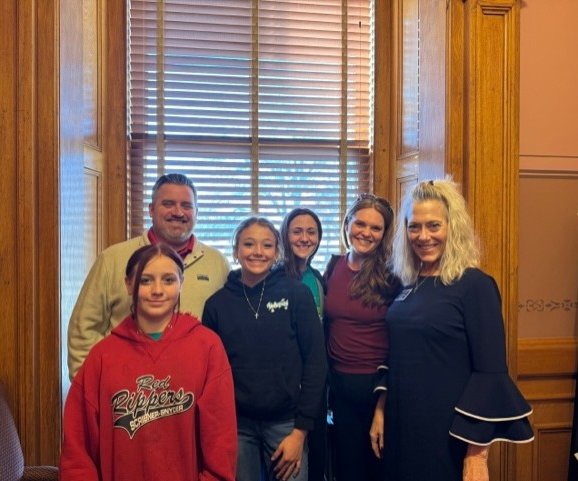

KINSLEY — A group of Edwards County residents gathered on Tuesday for a Town Hall meeting at City Hall in Kinsley to prepare written testimony in opposition to a bill headed for Senate hearing early Thursday morning in Topeka. County officials are worried that the quickly-advancing bill over water transfers in the state could lead to further overreach attempts in the future.
The proposal moving through the Kansas Legislature is becoming one of the most closely watched rural policy debates of the 2026 session not because it changes how much water Kansans can use, but because it changes who gets to decide. The Kansas Legislature has stepped in to resolve a 31-year battle over water rights and a proposed water transfer project.
House Bill 2433 would shift much of the authority over regulating water transfers and appropriations away from county governments and toward state regulators, primarily the Kansas Division of Water Resources and the state’s chief engineer. Supporters describe the bill as a clarification of existing law. Opponents see something much larger: a reduction in local control with long-term implications for rural communities.
Heather Strate, executive director of Edwards County Economic Development Corporation, told about 30 residents attending Tuesday’s town hall meeting that the deadline to submit written testimony for Thursday’s hearing regarding HB 2433 in the Senate Committee on Local Government, Transparency and Ethics was 9 a.m. Wednesday.
After giving background on the bill’s intent to serve as a template for further state control over county government, Strate guided residents wishing to submit testimony through the online form required for committee consideration. She also noted that a contingent of Edwards County officials, including herself, would be traveling to Topeka Wednesday to present oral testimony in opposition to the bill.
Background
The bill is being touted as a legislative attempt to resolve the decades old water battle between two northwest Kansas cities and Edwards County 70 miles to the south. Since 1995, Hays and Russell have sought to improve their water supply by purchasing the R9 Ranch in Edwards County and building a pipeline to transfer water from the Upper Arkansas to the Smoky Hills River basin. Over the course of three decades, the case has contributed to Kansas water policy changes, three lawsuits and one administrative case.
In December, the cities filed suit against Edwards County saying that the zoning regulations approved by county officials were unconstitutionally restrictive in preventing large water transfers out of the county. A decision on that suit is not expected for at least another 60 days.
At the meeting
Strate noted that the bill has been designated as “engrossed,” which means that it is being presented in its polished form suitable for floor debate in both chambers. This “fast-tracking” inhibited opposing testimony in the House, which passed the bill overwhelmingly with a vote of 116-6.
113th District Rep. Brett Fairchild voted against the bill, noting that he did not believe it was a “good fit” for his constituents. District 33 Sen. Tory Marie Blew sits on the Senate Committee on Local Government, Transparency and Ethics.
Although there is more time in preparation for the Senate hearing, it isn’t much. Strate said that she and a group of Edwards County officials have already booked lodgings in Topeka in preparation for Thursday’s hearing, which begins at 9:30 a.m.
While the current bill is focused on water rights authority, Strate shared her concern that its passage would essentially nullify decisions of all previous suits, as well as the one currently being considered.
“The bill essentially hands authority over to the Chief Engineer and Water Transfer Hearing Panel and insulates that authority from any local action,” she said.
Edwards County Attorney Mark Frame, also present at the meeting, offered his assistance to those composing written testimony, noting that he had previously submitted written testimony to the House Committee on Local Government for its hearing on Jan. 28.
“This bill did not arise in a vacuum,” Frame noted. “Many stakeholders have spent years engaged in detailed, evidence-based challenges to massive water projects and their overreach. Those challenges have exposed significant flaws about aquifer depletion and land-use impacts engineered behind closed doors by Kansas officials that have now gone through the revolving door to work for the firms that engineer this sort of work.”
Meanwhile, Pawnee County Commissioner Bob Rein was on the road to Topeka Tuesday afternoon. Rein, who also serves as president of the Kansas Natural Resource Coalition whose mission is to expose and eliminate state and federal government overreach, noted that due to the short time offered for testimony to opposition speakers at the Jan. 28 House hearing, he was the only one to speak in opposition to the bill. “Hays and Russell and their supporters had their presentations all ready, and of course, the proponents go first,” he said. “I was the only lonely in opposition at that hearing.”
Rein, as well as Frame, both believe that the bill, if passed, could lead to further erosions of county Home Rule, allowing further restrictions in zoning regulation, management and economic development that are currently under county authority.
“Our counties have not asked for this legislation and cannot stand by while the State continues to gain more and more power at the expense of local control,” Rein noted.
Best-case scenario
Richard Wenstrom, an Edwards County farmer, irrigator and charter member of the Water PACK organization that has led the fight against the R-9 Transfer Project since its inception, noted that it was never their intention to prevent water transfers in the state. “To us, it has always been a question of the amount,” Wenstrom said. “Our organization actually helped pass the Kansas Water Transfer Act. The issue is not whether transfers can occur, but whether they are done sustainably and lawfully.
As filed, Hays and Russell asked for — and the Chief Engineer approved — annual water allocations to be 4,800 to 6,700 acre-feet.
“We have always challenged this amount, because we have expert analysis performed by a groundwater hydrologist that pumping above 2,200 acre-feet per year would impair the local region.”
He noted that Hays has publicly stated they intend to only pump 2,000 acre-feet annually. “If they should agree to put that cap in the Master Order, then Water PACK and Edwards County will cease our opposition. Water PACK cannot rely on casual pledges,” he said.
While he is hopeful that the Senate Committee will stop progress on the bill, he noted that another course would be to table action for further study. “If they could table the bill so they can really look at it over the summer, that would be better than its current course,” he said.