The Barton County Historical Society is laying the tracks to bring a beloved piece of local history back to life.
Speaking at a recent Kiwanis Club meeting, BCHS Executive Director Justin Engleman shared progress on the extensive, volunteer-driven restoration of the Golden Belt Express – a vintage miniature train that has charmed area residents across multiple generations.
“We’re excited to see it back on the tracks very soon,” Engleman told the club.
A storied past
Built in 1949, the miniature locomotive originally entered service at the Anchor D Ranch in Belvidere. In 1989, local residents Bob and Carol Martin purchased the train from former owner Dick Robbins and relocated it to their Barton County farm, home to the Christmas Fantasy Village.
Getting the train off Robbins’ property, however, was no simple task.
“I spent a couple of hours last week with Carol Martin on her front porch ... and she told me that train was off-limits to everyone except Dick Robbins’ grandchildren,” Engleman recalled. “If you got caught on the property, there was a warning shot, and the second one meant business.”
Robbins eventually relented, selling the train to Bob Martin at a discount because he wanted to see it put to good use. Martin later sold the train in 2000 to Mike Cargill due to declining health. It was eventually purchased at auction by Jerry and Linda Marmie alongside Sharon and Ed Mauler, who donated it to the city of Great Bend.
When city officials opted not to use it, the local Golden Belt Model Railroad Club stepped in, arranging for the city to return the train to its donors so it could be gifted to the Barton County Historical Society in 2009.
The train underwent its first major facelift in 2010, when Luke Abbott – now a teacher in Ellinwood – sanded, repaired and repainted the engine for his Eagle Scout project. The Golden Belt Express then ran continuously in the courtyard behind the museum’s historic post office and depot until 2018, when stringent new safety regulations required two 18-inch rebars driven into every wooden tie, effectively forcing the museum to park the attraction indefinitely.
Bumping off the tracks
The train sat dormant until January, when Larry Gale – a retired educator, cabinetmaker, and the historical society’s resident caretaker – urged leadership to act.
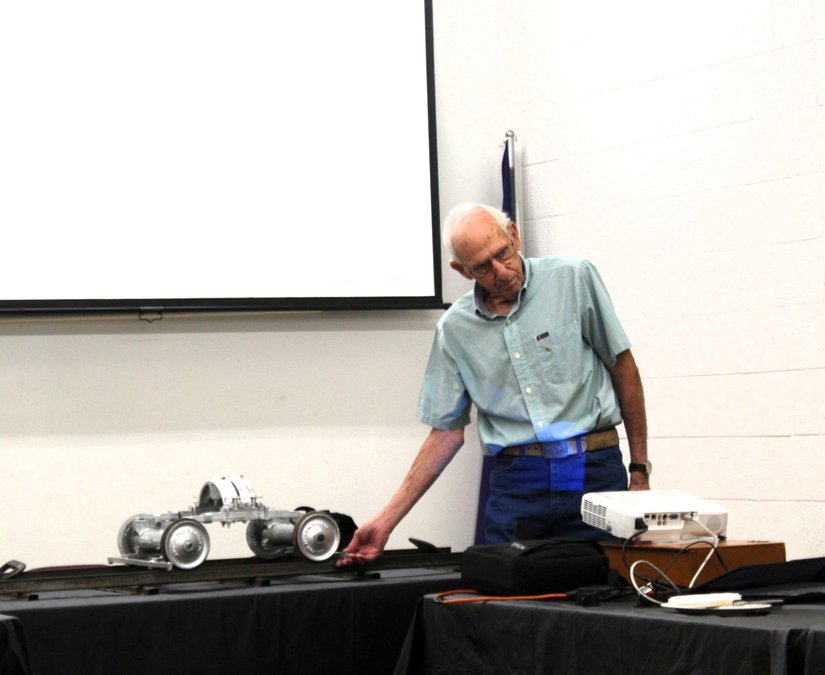
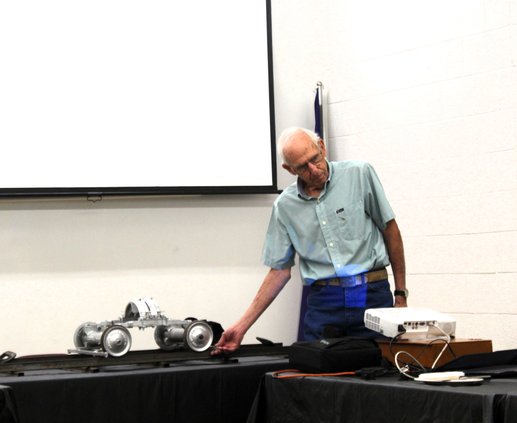
“He came to us and said, ‘Hey, we need to do something about this train,’” Engleman said. “So we started the process. We pulled it out of the building, got it off the tracks, tore down the building so it wouldn’t collapse on it, and have been working on restoring the train.”
While the exterior looked pristine, the internal mechanics had deteriorated significantly.
“It had sat there for several years. It was dirty, but the body was freshly painted,” Gale recalled. “We hoped it was pretty all the way through, but that was not the case.”
Sections of the track were missing, rails were improperly laid, and essential parts for a 1940s engine were nearly impossible to source. The original cast-iron wheels were cracked, and several bearings were worn out or water-damaged.
Despite the obstacles, the team tracked down replacement parts and partnered with a foundry in Belle Plaine to cast 25 brand-new wheels – a process funded through a donation by Dr. Terry and Judy Turner.
“It’s awfully interesting to go to a foundry,” Gale remarked. “I was able to watch iron pour out into a mold at 2,500 to 2,800 degrees ... to actually see molten steel poured is pretty fascinating.”
Community-backed budget
Restoring the locomotive, its three passenger cars and roughly 350 linear feet of track comes with an estimated $49,900 budget. The bulk of those funds will go toward major site preparations and infrastructure, including $14,000 for a new housing structure to shield the train from the elements and $12,000 for extensive concrete work.
Mechanical and operational upkeep make up another sizable portion of the costs, with $6,323 allocated for track and engine repairs, $3,677 for electrical updates, $3,000 to cast replacement wheels and $900 set aside for annual Kansas Department of Labor electrical inspections.
To ensure the line remains sustainable for years to come, the historical society has also earmarked $10,000 specifically for perpetual care and future maintenance.
The overall effort has relied heavily on grassroots community support to bring these plans to fruition. The project originally launched with $10,000 in seed money provided by a group of more than 180 local donors.
That momentum grew when Sharon Mauler, her son, and Jerry and Linda Marmie stepped forward to pledge an additional $20,000 in matching funds to help double incoming contributions.
Beyond direct financial gifts, community members are donating their time and labor to stretch the project budget even further.
A team of roughly 30 volunteers has logged over 750 hours on the project since February. Those hours carry double the impact, as standard grant guidelines allow the historical society to leverage volunteer time at a rate of up to $35 an hour toward matching fund applications.
Local donors and contractors have also chipped in with essential in-kind services, contributing key materials and labor for the necessary stone, sand and concrete work.
Rolling toward Thanksgiving
When the train returns, it will feature an upgraded foundation designed to keep it running smoothly for decades. Instead of laying ties directly on dirt, crews are pouring a specialized concrete base that the track assembly will securely float upon, complying fully with state labor and insurance safety standards.
If work stays on schedule, the Barton County Historical Society plans to officially unveil the restored Golden Belt Express over Thanksgiving weekend, giving local families and visiting children a nostalgic holiday ride into the past.