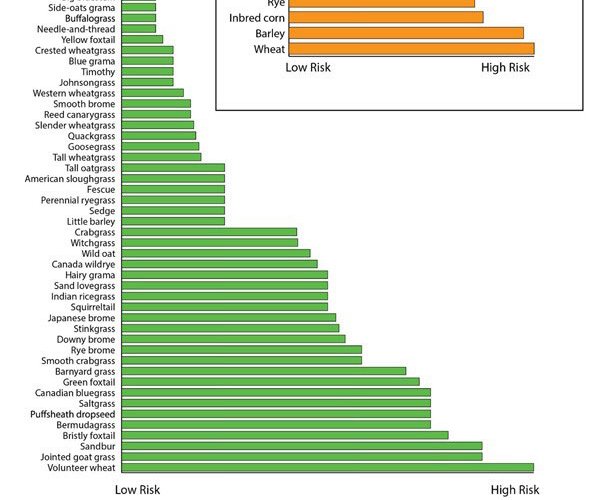
The drought monitor report as of Tuesday, Aug. 4 is basically unchanged from last week. Almost all of Barton County and much of the surrounding are is now in moderate drought. Southwest and South Central Kansas, especially the southwest, are showing a significant increase in drought. The state is continuing to trend drier and this upcoming week’s weather won’t help. The six-to-10-day forecast (Aug. 11-15) indicates a 50-60% chance of likely above normal for temperatures and a 33-40% chance of leaning above normal for precipitation. The eight-to-14-day forecast (Aug. 13-19) indicates a continued 40-60% chance of likely above normal for temperatures and a 33-40% chance of leaning above normal for precipitation. At least we have a chance of some precipitation.
Last week’s discussion focused on how our managed agricultural ecosystems differ from a natural one and how our crop plants are different from the weeds we deal with. As was said last week, these differences aren’t good or bad. Our managed ecosystem serves its purpose as does the natural one. However, our neat orderly system is “fought” by nature. So why do weeds love our system so much and a few ideas of what to do about it?
- Our neat, orderly system has space, open ground, for weeds to invade and spread. We also provide fertility to help them. They typically grow and establish themselves faster than our crops early in the season. They are better adapted to climate conditions. And, we provide them with a space to grow early in the season, good nutrition, and access to sunlight with little competition. Now, how do we minimize weed pressure, not just for a season but long term?
- First, the best weed control is a vigorously growing crop planted at the correct population and row spacing (as narrow as practical and depending on the crop and equipment). Second is starting with a weed free bed at planting. This may be done through tillage, chemically, or a combination of the two. It’s a good idea where possible to use a soil applied herbicide with residual activity. This gives the crop an opportunity to “get ahead” of weeds.
- When using herbicides, vary the modes of action (how it kills the plant) and control weeds as young as possible. Unless no-tilling, cultivation can be used but remember that small-seeded crop seeds when buried will just sit in the soil until brought back to the surface. And the key here is knowing your weeds, selecting the best herbicide(s) and using the full labelled rate as determined by growth stage and soil/climate factors.
- A good cover crop that is killed and left in place helps suppress weed pressure. Allowing residue to accumulate on the soil surface, especially with no-till, helps decrease weed pressure. No-till, combined with aggressive weed control, over time can help deplete the seed bank and decrease pressure.
There’s more. It would be great to eliminate herbicides but almost impossible. The goal should be a combination of chemical and cultural practices.
Dr. Victor L. Martin is the agriculture instructor/coordinator for Barton Community College. He can be reached at 620-792-9207, ext. 207, or martinv@bartonccc.edu.