Kansas voters may soon confront the most significant shift to the state’s judicial system in nearly seven decades. A proposed constitutional amendment, set for the August 2026 ballot, would replace Kansas’ long-standing merit-based system for selecting Supreme Court justices with direct, partisan elections.
If approved, Kansas would join a small group of states that choose their highest-court judges on partisan ballots. Critics warn that such a move could draw political pressure into rulings on issues ranging from abortion and school funding to voting rights and redistricting, according to the Kansas Information Network.
“The partisan election process proposed in this resolution would shift the priorities of the justices on the Kansas Supreme Court to emphasize re-election in their decisions rather than faithfulness to the Kansas Constitution,” said Mike Fonkert, deputy director of Kansas Appleseed, in Feb. 25 testimony opposing the proposed amendment.
Since 1958, Kansas has relied on a merit-based model rooted in the Supreme Court Nominating Commission, a nine-member panel created in the aftermath of the state’s notorious “Triple Play” scandal.
Today, the commission is made up of five attorneys — one from each congressional district, plus a statewide chair — and four non-lawyers appointed by the governor. When a vacancy opens, the panel reviews applicants, interviews finalists, and sends three recommendations to the governor, who must make a choice within 60 days. Justices then serve six-year terms, standing for retention after their first full year.
That process grew out of public outrage in 1956. In his final days in office, outgoing governor Fred Hall resigned so that his lieutenant governor, John McCuish, could become governor and appoint him to a Supreme Court seat that had been vacated hours earlier, according to Humanities Kansas. The Kansas City Times later called the maneuver “A Brazen, Raw Deal for Kansas Justice.”
Voters responded swiftly, approving the 1958 constitutional amendment that removed the court from direct partisan control. The new proposal would unwind much of that system.
Currently, the court leans moderate, with appointees from Democratic and Republican governors, including three from Gov. Laura Kelly and one from former governor Bill Graves (R).
If the amendment is approved, the Nominating Commission would be dissolved, and justices would be elected statewide in partisan contests. Terms would remain six years, with staggered elections beginning in 2028:
• Positions 1–3 in 2028
• Positions 4–5 in 2030
• Positions 6–7 in 2032
Vacancies between elections would be filled through special elections under rules crafted by the Legislature.
The change would move Kansas toward a system it used from statehood through the mid-20th century, when justices ran in elections defined largely by party affiliation, says the Kansas Information Network.
Democratic lawmakers argue the push to change the appointment process stems from frustration among conservative legislators after a series of high-profile rulings on school funding, reproductive rights, and constitutional protections.
“I think we know by now money is really damaging to politics. People already hate political ads; people already hate divisiveness. To do this at the judicial level is just a broadening of our current political discourse,” said Rep. Rui Xu (D-Westwood) in a recent interview. Xu pointed to Wisconsin’s Supreme Court race last spring – the most expensive judicial election in U.S. history, topping $100 million – as a cautionary example.
Some conservatives, however, say the system places too much influence in the hands of attorneys on the commission and not enough in the hands of voters.
“This is fundamentally about having a government that is more representative of its people. We shouldn’t carve the Judiciary out as some special case where the people all of a sudden have little to no say,” said Sen. Doug Shane (R-Louisburg) in a recent interview.
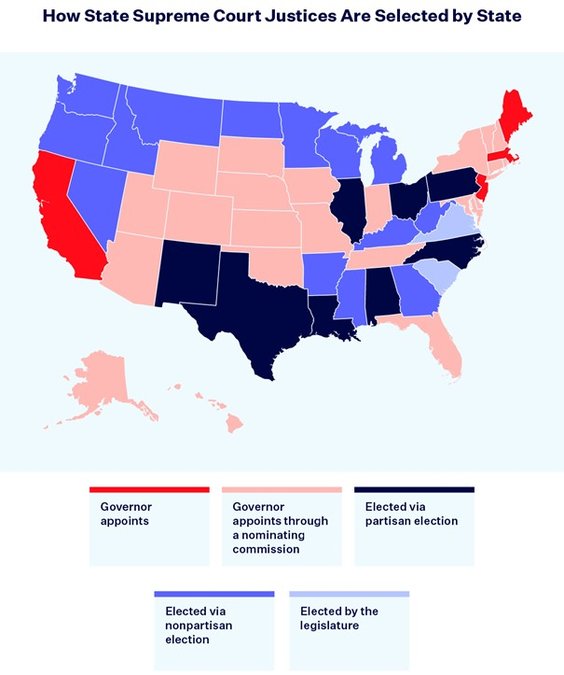
Nationwide, judicial selection systems vary widely. According to Democracy Docket:
• 26 states use a merit-based appointment system similar to Kansas.
• 24 use some form of judicial election.
• Only eight choose their Supreme Court justices through partisan elections.
Source: Democracy Docket
If Kansas joins the group of states with partisan elected judiciaries, civil-rights organizations and legal scholars say the impact could be far-reaching, bringing campaign donors, party litmus tests, and ideological pressure into judicial decision-making.
“This referendum seeks to dismantle Kansas’ merit-based judicial selection system and replace it with partisan judicial elections,” said Rashane Hamby, director of policy and research for ACLU Kansas, in a March 13 statement to the Kansas House. “This would inject politics into our courts, undermine judicial independence, and erode public trust.”
The Brennan Center for Justice notes that partisan judicial campaigns tend to heighten political tensions around rulings, particularly on issues like abortion access, voting rules, redistricting, and public education.
Research supports those concerns. A study in the Journal of Law and Courts found that judges selected through partisan elections, and those appointed for life, cast more party-aligned votes on controversial issues than judges chosen under nonpartisan or merit-selection systems.
Other researchers have reached similar conclusions. “[Elections] involving partisan politics lead to more ideological justices and that, among that subset, Republican affiliated justices will be the most extreme,” said Alan J. Simmons, director of the Center of State Policy and Leadership at the University of Illinois Springfield, in the Sage Journal.
Donivan Bullins is a University of Kansas senior from Lenexa, studying political science and journalism.