CLAFLIN — Land and Homesite Evaluation — sounds like a pretty intense contest face up, right? It definitely is. This contest involves a lot of thinking skills in regard to our most highly valued resource, the land. As stewards of the land, we are charged with the responsibility to be the best managers and caretakers of the soil we walk on every day – from spading the garden, to planting grass, and if you’re fortunate some day, determining the best soil site to locating a home.
Where can a student get this education? In the high school Agriculture Education program, that’s where — and the Land and Homesite Evaluation CDE (Competitive Development Event) is just the hands-on outdoor lab that can help reinforce that classroom training.
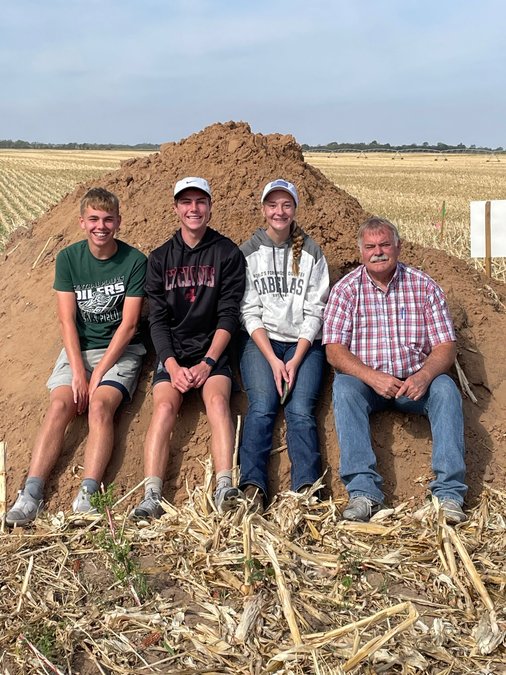
Three Central Plains ag students took advantage of that opportunity as they competed in the State Area Land and Homesite event hosted by the Fairfield Ag.-FFA program on Oct. 5. Still one member shy of completing a team, Central Plains did gain an interested participant, Callun Rogers in a week’s time to go along with two experienced students, Melissa Donecker and Peyton Ryan, as they vied for individual status. Individually, Donecker finished in 21st, Ryan in 31st, and Rogers in 41st of a 47 individual field. Even with three, the incomplete team did beat two others, finishing in 11th of 13 teams.
What exactly is this competition all about? It challenges the contestant’s knowledge in the soil’s productive ability to land classification and the effect it has on a homesite, be it foundations – either with or without basements – septic systems, lawns and landscaping, and sewage lagoons.
In this process, the student has to have an understanding of soil type, shrink-swell, permeability, erosion, surface runoff, water table, depth of soil, flooding, slope, soil and fertilizer amendments, and mechanical and vegetative land treatments.
All this happens at four or six sites (holes) 100 by 100 feet, dug to a predetermined depth with either a backhoe or high loader, four being land and two for homesite. Two stakes, within the boundary, identify the slope that students will need to determine. Then they have to determine all of the aforementioned factors, starting with surface and sub-surface textures and then work their way through in accordance with decisions they make along the way. In a way, it’s like solving an algebra problem--determining the unknowns, plugging them in, condensing and eliminating, and finally, a final answer.
Ag instructor/advisor Wayne DeWerff and company hope to recruit some more talent to field at least a couple teams. This isn’t an easy contest to get the hang of — there’s definitely the need for study time, practice, and redundancy for long-term memory. But oh, what a practical contest for a person’s life beyond high school when it comes to buying/owning a home or buying/renting ground for production agricultural practices or a homesite establishment!