Joining the Navy may have been the best decision Mike Harbaugh ever made — and in the same breath, the timing may have been the worst. He enlisted during the Vietnam War, a conflict that would leave wounds that still, more than half a century later, occasionally force their way back into the light.
When Harbaugh graduated from Wilson High School in 1965, he was, by his own admission, a rowdy teen without a clear direction. His father had retired from the Navy, so the branch was a natural choice. He enlisted in 1966 and arrived in Vietnam on April Fool’s Day, 1967 — a date that would prove bitterly apt.
“That was all during the Tet Offensive,” he said quietly. “That was the biggest offensive that the North Vietnamese put on the entire war, and that was a tough time. We lost a lot of people. It was just a really, really bad, bad time.”
Harbaugh served as a Navy corpsman — a medic — in and around the Da Nang area. He was there when more than 57,000 Americans would ultimately die in a war the public had turned against. He remained in Vietnam until April 4, 1968, then served out the remainder of his enlistment before getting out four months early when the war wound down.
A Pen Pal Becomes a Partner
While Harbaugh was wading through some of the worst months of the war, an unlikely lifeline arrived in the form of letters from a young woman he had never met.
Vivian Duryee’s mother and Harbaugh’s mother had been best friends in high school. When Vivian’s mother saw a notice in the Wilson World newspaper that he was shipping out to Vietnam, she nudged her daughter to write to him. Vivian did.
“She started writing me, and I wrote back through some very, very difficult times for me over there,” Harbaugh said. “She kind of helped get me through them.”
By the time he came home, the Duryee family had moved to Great Bend. Harbaugh used 20 days of leave to meet Vivian in person, then returned at Christmas for two weeks, where her father put him, as Harbaugh laughed, “through the ringer.” The letters kept coming. The feelings deepened.
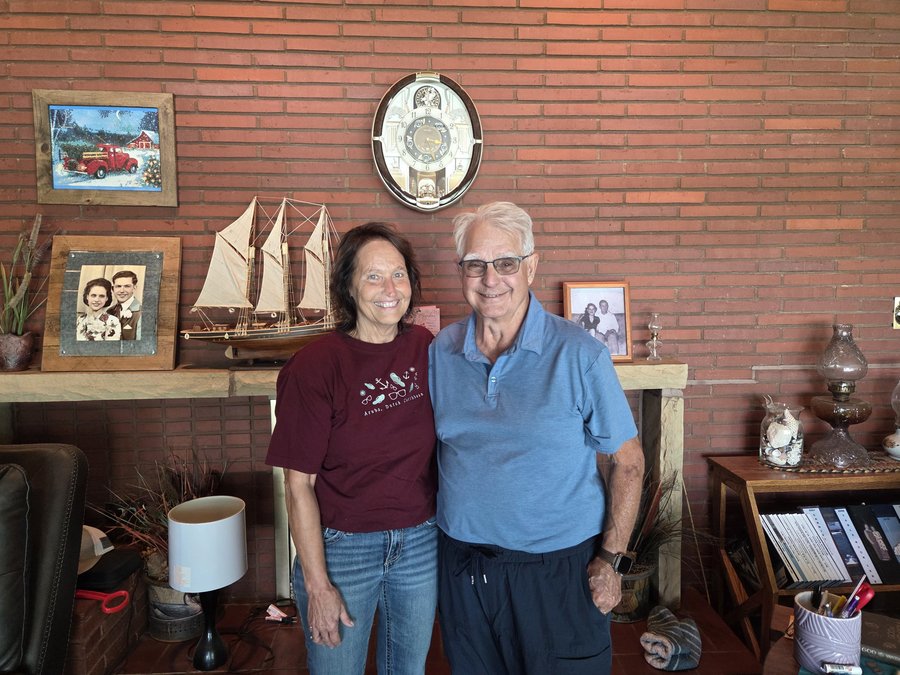
“I think we fell in love with each other through our writings,” he said. He proposed. She said yes. They married in July of 1969, raised four sons, and now have 11 grandchildren, most of them close by.
From Mechanic’s Helper to Safety Expert
The war was over, but Harbaugh still needed to build a life. He settled in Great Bend with Vivian and started at the bottom — a mechanic’s helper on 10th Street, then two years with the Fire Department. But his family was growing, and he needed more.
He started asking around: What’s the best-paying job for someone without a college degree who is willing to work? Every answer pointed to the same place — the utility company, then known as Western Power. He signed on as an apprentice at $7 an hour and graduated the four-year program earning $15 an hour. “That was a heck of a good job,” he said.
His medical background as a corpsman caught the attention of his superintendent, who tapped him to run safety programs for linemen — without extra pay or time off to build the curriculum. He did it anyway. Word traveled. A statewide REA program in Nebraska called and offered him a job. He took it, trading up in salary while trading away time with his family: 33 rural electric utilities to cover, each one requiring a visit once a month.
His career eventually took him to the national REA organization in Washington, D.C., and then to North Fort Myers, Florida, where he worked for eight years. When Vivian told him she wanted to move back to Kansas to be near her family, he listened. He moved them home to Great Bend in 1981 — then took a call from a man in Alaska.
The Alaska job pulled him away for four more years of long-distance marriage — visits once or twice a month, letters filling the gaps, history repeating itself in a gentler way. “I loved her so much I just quit my job to come back,” he said simply. “I still love her more than ever.”
The Welcome That Never Came
Ask Harbaugh what it meant when the country finally began recognizing Vietnam veterans, and he pauses. Then he tells the story of San Francisco.
The plane coming back from Vietnam had stopped to refuel in Japan, then Alaska, before landing on American soil. As the soldiers prepared to deplane, they were warned: Change out of your military fatigues before you walk out into public. The country doesn’t want you here.
Harbaugh was headed toward the airport bathroom to change when a young woman walked directly toward him on a collision course, close enough that he stopped. She stopped. She smiled — a gorgeous smile, he remembered. He thought for a moment she might hug him.
She spit in his face.
“I went to the bathroom, washed my face, changed my fatigues, and went about my business,” he said.
For decades, he told almost no one he had served in Vietnam. The memories — things that happened that, as he put it, “were not good things” — he learned to seal away. A psychiatrist once gave him an unusual prescription: In your mind, build a wooden box. Sand every piece of wood to a perfect finish. Cut the angles just right. Glue it together. Put all the bad memories inside it. Close the hatch. Lock it.
“That was a lifesaver for me,” he said. “The only bad part about it is that sometimes that box opens itself. Even yet today — you just do your best to keep that lock on it, and when you see that it’s opened, you put that lock right back.”
It wasn’t until 2022 or 2023, he said, that he began letting people know he had served in Vietnam at all.
Steak, Lobster, and Scuba Diving: One Good Day
Not every memory from Vietnam is locked in that box. One of them Harbaugh tells with the easy grin of a man reliving a treasure.
Late one night, a group of Air Force special forces came into the hospital where he was working the ER. Among them was a soldier in rough shape — three gunshot wounds, critical. Harbaugh put in a chest tube and worked on him through the night. The man survived, was transferred to a larger hospital in Saigon, and eventually recovered.
Some time later, a chopper landed at their landing zone and a man climbed out hollering Harbaugh’s name. It was his former patient — fully recovered and with a plan.
“Get in that chopper, we’re going.” Where? “None of your business.” Harbaugh protested that he needed to clear it with his commanding officer. “Screw your CO. Get in that helicopter.”
They flew to a private, isolated beach on the coast — the most beautiful one Harbaugh had ever seen. Three Vietnamese women were waiting. Off the helicopter came ice chests packed with steaks, shrimp, and other luxuries. Then came scuba diving equipment.
Harbaugh had never scuba dived a day in his life. His patient strapped a tank on him, stuck a regulator in his mouth, and offered the only instruction he would receive: “Don’t forget to breathe underwater.”
Down they went, 90 feet, picking lobster off the ocean floor. They brought the catch back up to the women, who cooked steak and lobster and shrimp for supper that night on the beach.
“That was the really good, good day I had in Vietnam,” he said.
A Monument, a Mission, and a Message
Last year, Harbaugh joined a committee of local veterans that worked to build a Vietnam Veterans memorial at Veterans Memorial Park in Great Bend. He was especially pleased that the memorial’s centerpiece is a helicopter.
“Helicopters were so prominent and so useful and saved so many lives over there,” he said. “They were able to go into those battle zones and bring people back to hospitals.”
Due to PTSD and physical injuries — heart issues, knee problems, and neuropathy — Harbaugh is now recognized as 100% disabled through the VA. “Took me about 10 years to get it, but I finally got it,” he said.
Now he makes a point of reaching out to younger veterans returning from Afghanistan and Iraq, men and women he recognizes in his own younger self. He lets them know a VA representative visits the local VFW once a month and can help them navigate the paperwork and the process.
“If I can help you in any way, let me know,” he tells them. “I’ll be happy to help.”
Harbaugh looks back on the decision to enlist with complex feelings. The military straightened him out, gave him skills, and — in one of the stranger gifts a war has ever delivered — led him to Vivian. But Vietnam itself? “If I had to redo that,” he said, “I wouldn’t have done it.”
He did it anyway. He came home. He washed his face, changed his fatigues, and went about his business.