When we first looked at this tree, there appeared to be very little reason for concern.
The crown looked relatively healthy. There was no dramatic canopy decline, significant discoloration, or obvious indication that the tree was in immediate trouble. Had we evaluated it only by what we could see above the ground, we may have assumed everything was fine.
But experience has taught us that what is visible does not always tell the entire story.
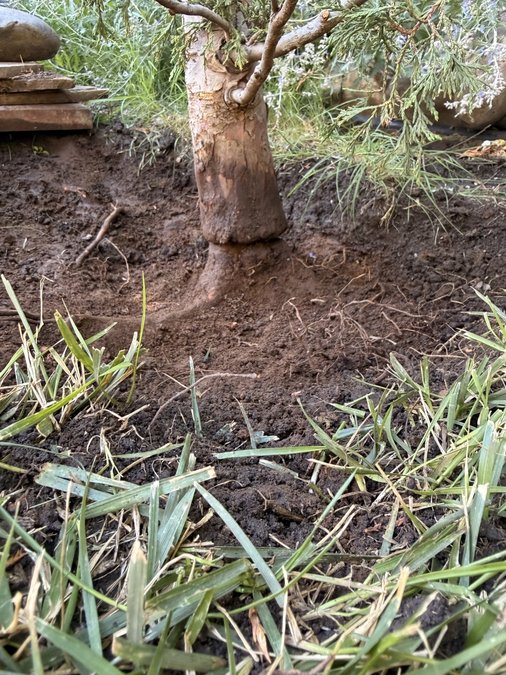
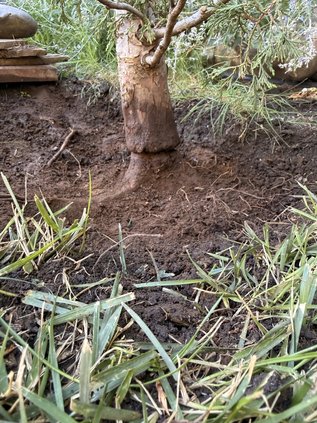
The base of the trunk immediately raised concern. Instead of widening naturally as it entered the soil, the trunk went almost straight into the ground like a telephone pole. That appearance often indicates that a tree was planted too deeply.
A tree can tolerate improper planting for years without displaying obvious symptoms. However, when the trunk and root flare remain buried, the possibility of restricted root function, decay, girdling roots, instability, and premature decline continues to increase.
We began carefully removing the soggy, compacted soil from around the base of the tree so we could locate and expose the root flare. As we worked, we uncovered an additional and unforeseen problem.
There was a piece of twine wrapped around the tree near the root flare that was never removed in the planting process. It appeared that the tree had been restricted since its time in the nursery. As the trunk continued to grow, the twine remained in place and gradually tightened around it.
From above the ground, the tree looked acceptable. Below the ground, it was being strangled.
The client had not noticed significant decline because the tree had learned to survive within its limitations. But surviving is not always the same as thriving. What she was seeing may have been only a fraction of what the tree could have become under healthier conditions.
Removing the compacted soil and cutting away the twine cannot undo every year the tree spent under restriction. However, it gives the root system more room to function and the tree a much better opportunity to recover, grow, and reach more of its potential.
I believe the same is often true in our own lives.
We look at ourselves or at the people around us and make judgments based on what is visible. Someone may appear successful, productive, healthy, or content. Yet underneath the surface, there may be fear, grief, insecurity, exhaustion, resentment, or an old wound quietly restricting who they are becoming.
Contentment is important. It brings peace and gratitude into our lives. But contentment should not become an excuse to ignore the things that are quietly limiting us.
There is a difference between being thankful for where we are and refusing to examine what may be holding us back.
Sometimes we must be willing to dig.
We must look honestly at our habits, relationships, attitudes, and decisions. We must ask whether something from an earlier season of life is still wrapped around us, restricting our growth long after it should have been removed.
We cannot change everything that has happened to us. We cannot recover every lost opportunity or erase every painful season. But we can identify what is still limiting us and begin removing its influence over our future.
That may require a difficult conversation, forgiveness, counseling, prayer, a healthier boundary, or the courage to admit that something is not as healthy as it appears.
We should approach others with the same awareness. Not by assuming we understand everything happening beneath the surface, but by showing enough patience and compassion to recognize that there may be more to their story.
We must understand as well, that God does not expose what is hidden simply to embarrass or condemn us. He reveals it so healing and restoration can begin.
The tree looked fine until we understood what we were looking for.
The same may be true in our lives.
Removing what has restricted us cannot change the past. But it may create the room we need to grow into more of who God created us to be.
A Practice to Cultivate
Try to take a few quiet minutes this week and consider what may be happening beneath the surface of your life.
Is there a habit, fear, wound, relationship, or belief that may be quietly restricting your growth?
Choose one area that needs attention and take one honest step toward addressing it. That step may be as simple as a prayer, a conversation, an apology, a boundary, or simply admitting that something is not as healthy as it appears.
We do not have to repair everything at once. Healthier growth often begins when we become willing to look more closely and remove what no longer belongs.
‘Well Rooted’ is a new column to the Great Bend Tribune written by Jeremy Elliott. Elliott owns a lawncare business and lives in the Great Bend area.