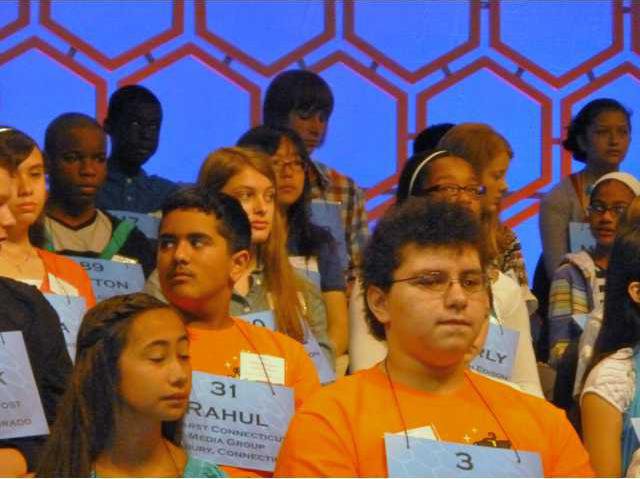
A future winner of the Great Bend Tribune’s Sunflower Spelling Bee could potentially compete in an international spelling bee, according to an announcement made during the Scripps National Spelling Bee.
As the national bee got under way on May 29 in Washington, D.C., the E.W. Scripps Company outlined a vision for a new, international spelling bee that could be staged as soon as December 2013.
The early-stage concept of the international competition features teams of three spellers from the participating countries, including the United States, chosen through national spelling bees around the world.
Scripps has sponsored the National Spelling Bee for eight decades. This was the Tribune’s fifth year to sponsor a bee contestant. Clara Wicoff, who will be a freshmen this fall at Iola High School, was the Sunflower Spelling Bee champion for the third time. Having completed the eighth grade, this was her final year of eligibility.
Lisa Wicoff, Clara’s mom, writes, “Going to the National Spelling Bee is a once-in-a-lifetime experience that we have had the privilege to experience three times. But, that experience was earned only after hundreds of hours of study. Clara started studying for the bee this year shortly after her volleyball season ended in October. After a written test at her school, school bee, county bee, and the Sunflower Regional Bee, she continued to study as time allowed for the National Bee. Hopefully, the time spent studying and the vocabulary and knowledge gained from this study will serve her throughout her life, but perhaps the best lessons learned were those about hard work and perseverance.
“Getting to the National Bee is a family affair. Clara’s father helps her study the Italian and Spanish words, while I help her with the rest. Her three brothers were very understanding of the extra time that it took away from them in order to help Clara study. Household chores, activities, and leisure time are all sacrificed to studying in one way or another. But, in the end, spelling together provides a reason for Clara and I to spend time together, and that is probably the best thing that has come from her spelling experiences for me as a mom.”
Lisa Wicoff adds that studying spelling has expanded Clara’s world. “Not only has she learned words from dozens of languages, but also made friends from all across the United States with similar internal motivations and love for words.”
She said one of the best ways to study for the National Spelling Bee is to read. “We also utilized the Scripps resources available online, and created many of our own word lists through a paid subscription to Merriam Webster’s Third Unabridged online edition. It is ‘favorited’ on every computer we own.”
The Wicoffs are also asked if any of Clara’s three brothers will attend future spelling bees in Great Bend. Lisa Wicoff said the boys vacillate on their interest in spelling, but they haven’t ruled it out.
The prospect of an international bee reflects a growing interest, said Paige Kimble, director of the Scripps National Spelling Bee.
Since 1976, the Bee has included competitors from outside the United States. This year, there were spellers from the Bahamas, Canada, China, Ghana, Jamaica, Japan, New Zealand and South Korea.
“As English has become the global lingua franca, speakers and learners of English in the United States and around the world have found inspiration in the Scripps National Spelling Bee,” Kimble said. “Their interest has, in turn, inspired the vision of a spelling bee for the world.”
The international spelling bee would be unique in how it rewards its participants. Kimble said awards could be given for the highest achievements by spellers whose first language is not English and the best humanitarian uses of the English language, as well as the highest overall ranked competitors.
Sunflower speller's mom writes about D.C. experience
Getting to National Bee was a family project