This could be huge. There have been opportunities in the past that we haven’t taken, and people still talk about those.City Administrator Logan Burns
This is the first of a three-part series examining the STAR Bond project at the Great Bend Expo Complex.
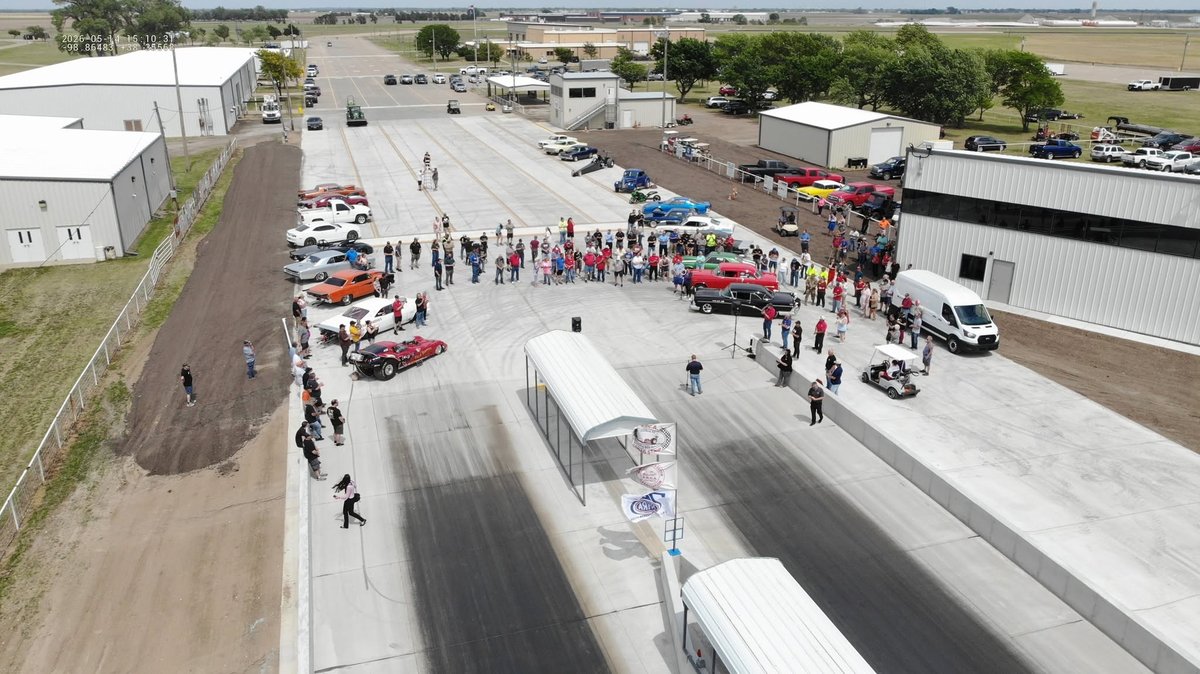
When the SRCA Dragstrip reopened this spring after years of uncertainty, it marked more than a return to racing in Great Bend. It was the first visible sign of something far more ambitious — a $56 million development project that would make Great Bend the only municipality in Kansas to take on a STAR Bond project of its own.
The plan centers on a major expansion of the dragstrip at the Great Bend Expo Complex, paired with a new sports and banquet complex, and anchored by a hotel and restaurant development on 10th Street. If it comes together as envisioned, city officials say it could position Great Bend as a regional destination for motorsports and athletic tournaments — and help fund infrastructure improvements the city says it can no longer afford to delay.
City Administrator Logan Burns has spent months trying to explain a financing structure that he himself admits takes some time to wrap your head around. But the broad outline is this: Great Bend is proposing to borrow roughly $30 million, use a state financing tool called STAR Bonds to reduce that debt load over time, and ask voters in November to approve a sales tax that would serve as the project’s financial safety net.
“People need to know exactly what this is, what it isn’t, and know the risk and the reward,” Burns said. “This could be huge. There have been opportunities in the past that we haven’t taken, and people still talk about those.”
What STAR Bonds are — and aren’t
STAR Bonds — an acronym for Sales Tax and Revenue Bonds — are a Kansas economic development tool that allows cities to issue bonds repaid through sales tax revenue generated within a specially designated district. Great Bend has already designated a STAR Bond district that includes two separate areas, a hotel/restaurant property on 10th St. and the Expo Complex. The state’s share of sales tax, normally 6.5 cents on the dollar, gets redirected within the district to repay bond investors rather than flowing to Topeka. The city’s share and a portion of Barton County’s 1% sales tax can also be captured with approval.
The key mechanism is the increment. Before the district is approved, a baseline snapshot is taken of existing sales tax activity at the site. Everything above that baseline — the new economic activity the project generates — becomes available to repay STAR Bond investors. Existing taxing entities keep their baseline. Only the new growth is redirected.
The state’s like, we’re not making this anyways. Anything else is the cherry on top, and so we can give that cherry away for 20 years.Burns explained.
“The state’s like, we’re not making this anyways,” Burns explained. “Anything else is the cherry on top, and so we can give that cherry away for 20 years.”
In Great Bend’s case, that baseline is essentially zero. The snapshot was taken when the dragstrip was not operational and the 10th Street development parcel was vacant, meaning neither property was generating meaningful sales tax activity. That means virtually all of the new sales tax revenue generated within the district becomes available to repay STAR Bond investors, rather than only the growth above an existing baseline.
STAR Bond projects are typically associated with large private retail developments — the Kansas Speedway and the surrounding Legends area in Kansas City are the most prominent examples — where nationally recognized anchors like Cabela’s or Dick’s Sporting Goods give investors confidence that revenues will materialize.
Great Bend’s project is different in that the city itself is the property owner.
“We’re the only municipality that I’m aware of that has ever tackled a STAR Bond project,” Burns said. “Most of it (STAR Bond projects) is private investment,” he added. “Those private investors, they bring in these huge national retailers that investors know are going to pay back these STAR Bonds. We don’t have that.” Great Bend’s anchor, Burns said, is the SRCA dragstrip.
The STAR Bond program, which had been set to expire in June, was recently extended by the Kansas Legislature through 2031 — a development Burns said relieved significant anxiety for the project team.
The project: Two sites, one district
The Great Bend STAR Bond District encompasses two properties. The primary site is the SRCA Dragstrip at the Great Bend Expo Complex. The second is a development parcel at 3017 10th St., where a Hampton Inn, a 7 Brew drive-through coffee and beverage shop, and at least one additional restaurant are planned. That 10th Street property has been sold to developers. Hotel construction has not yet begun. Burns told the county commission Tuesday that 7 Brew is preparing to begin construction — a process he noted is relatively quick, with the modular structure brought in by truck and set on site.
The hotel and restaurant development is privately funded, though the city approved several incentives for the developer including a 2% Community Improvement District (CID), a 20-year property tax TIF returning 100% of the property tax increment to the developer, an Industrial Revenue Bond (IRB) for sales tax exemption on construction materials, and a $500,000 grant. By including those properties in the STAR Bond district, the city gets to count approximately $22-25 million in private investment toward the project’s total footprint, and the sales tax collected at those properties goes toward financing the project at the Expo Complex. That matters because STAR Bonds can cover up to 50% of a project’s total cost, and the private development inflates that total, increasing the amount of STAR Bond proceeds the city can potentially access.
“We basically get to say this money is all part of this project, even though we’re not paying for it,” Burns said. He added the private development on the 10th Street property is critical to the STAR Bond calculation. Without the Hampton Inn, 7 Brew, and the yet-to-be-announced restaurant in the district, he said, the city’s STAR Bond proceeds would drop significantly — because unlike established national retailers, a dragstrip has no reliable historical revenue data to offer investors confidence in the projections.
The total STAR Bond project — city investment plus private development — is valued at approximately $56 million. While the maximum STAR Bond proceeds the city could receive is $22 million, Burns said the current scenario projects approximately $12.095 million in proceeds — well below the maximum.
What the city is actually building
At the Expo Complex, the city is planning a significant expansion that encompasses two main components: improvements to the SRCA Dragstrip to bring it up to national event standards, and a new sports and banquet complex on the north side of the property. The dragstrip improvements would include covered and open grandstands, suites for corporate sponsors, concessions, restrooms, bathhouses, lighting, and sound infrastructure. “The entire fan experience,” Burns said.
The current dragstrip reopened for racing in May after the city completed slip-form paving work that Burns says produced what track preparation experts confirmed is the flattest poured track in the nation. Burns said the technique may influence how NHRA builds tracks going forward.
NHRA itself has been closely involved. Burns said prominent NHRA names have committed to help design the Great Bend facility and plan to attend the July 6 public hearing.
“They said, ‘We will come to the table with you. We’ll help you design this if you want us to come to the public hearing,’” Burns said. “SRCA is known all over the nation. I’ve learned a lot in this process about how much NHRA loves SRCA.”
The city also has two NHRA-sanctioned races and the ET Finals on the schedule this year. Burns said he was surprised the organization committed those events back to Great Bend in its first year of reopening. The long-term goal is a national event — something Burns says NHRA won’t guarantee in advance, but which the expansion is designed to make possible.
A livestock arena, hangar, restaurant, and outdoor amphitheater are listed in the project plan as future phase considerations.
What the finished complex will look like remains to be seen — no renderings have been released, a deliberate decision Burns said came from developers who warned that premature visuals tend to generate negative reaction before designs are finalized. What is clear is the scope of what’s being proposed: a transformed Expo Complex designed to draw racers, athletes, and visitors to Great Bend from across the region and beyond.
In Part 2 of this series, the Tribune breaks down how the city plans to pay for it, how STAR Bonds work as a financial mechanism, and why one November ballot question may determine whether any of it moves forward.