This could be huge. There have been opportunities in the past that we haven’t taken, and people still talk about those.City Administrator Logan Burns
This is the final installment in a three-part series on Great Bend’s proposed STAR Bond project at the SRCA Dragstrip and Expo Complex. Part 1, published June 13, covered what STAR Bonds are and what the city plans to build.
Part 2, published June 16, examined the financing structure and the economic case behind the project. This installment looks at the financial safety net the city says it needs, the infrastructure crisis driving urgency behind the November sales tax vote, what the county has been asked to contribute, and the path ahead.
Public hearing set
The next major milestone for the STAR Bond project is a public hearing set for July 6, during the regular Great Bend City Council meeting at 5:30 p.m. at City Hall.
The city’s bond counsel, Dominic Eck of Gilmore & Bell, and financial advisor David Arteberry of Stifel Nicolaus are both expected to present.
Following the public hearing, the city council will vote on whether to formally adopt the project plan. A two-thirds majority vote (six of eight councilmembers) is needed for it to pass.
The Expo Complex re-imagined as an athletic and motorsports destination designed to draw hundreds of thousands of visitors a year. To help fund what is beneath the streets of Great Bend: aging water lines, contamination, and a wastewater treatment plant that can no longer be ignored.
City Administrator Logan Burns doesn’t sugarcoat what it takes to address all of it — a proposed STAR Bond development project and a November sales tax vote that he says could fund both.
The sales tax connection
Nearly everything about this project depends on a three-quarter cent citywide sales tax that Burns says will be put before Great Bend voters in November.
The tax would be divided into three equal parts: a quarter cent for wastewater treatment plant improvements, a quarter cent for property tax relief, and a quarter cent tied to the STAR Bond project.
The city has pending State Revolving Fund applications for approximately $26 million toward the treatment plant, and Burns said the water infrastructure needs are pressing and unavoidable.
“If the sales tax doesn’t pass, we’re going to have to hike up (water) rates,” he said. “We’re working on information right now that we’ll probably put out in July — here’s what this can do, and if not, here’s what your utility rates are going to go to.”
The sales tax proposal itself has evolved alongside the STAR Bond project. When the city first discussed the idea in April, the conversation centered on a half cent tax split between property tax relief and infrastructure improvements. As the STAR Bond financing structure took shape, a third quarter cent was added — tying the infrastructure crisis and the development project together under a single ballot question voters will decide in November.
On the STAR Bond side, the quarter cent allocation is designed to ensure the city can cover its $1.3 million annual GO (general obligation) bond payment regardless of how the dragstrip performs. Burns said the operating profit projections for the dragstrip and sports complex together — roughly $780,000 to $848,000 annually — fall short of that payment on their own.
“I would be very nervous to proceed without that sales tax in place,” Burns said. “You don’t know what you’re going to be generating in year one or two. That sales tax is the safety net.”
If the dragstrip performs well enough to cover the bond payment through operating revenue, the sales tax allocation intended for the STAR Bond can then instead be redirected to water and sewer infrastructure, or additional property tax relief. Burns framed it as a best-case outcome.
In a perfect world, Burns said, the project’s success would accomplish two things at once: the sales tax revenue won’t be needed to cover the STAR Bond payment, and visitors to the dragstrip and complex will be helping fund the city’s infrastructure needs, not just residents. “If this thing is wildly successful, everybody’s helping pay for the infrastructure, and we’re not raising water bills.”
We’re playing catch-up. Water is going to be the biggest thing we have to tackle in the future.City Administrator Logan Burns
Water Woes
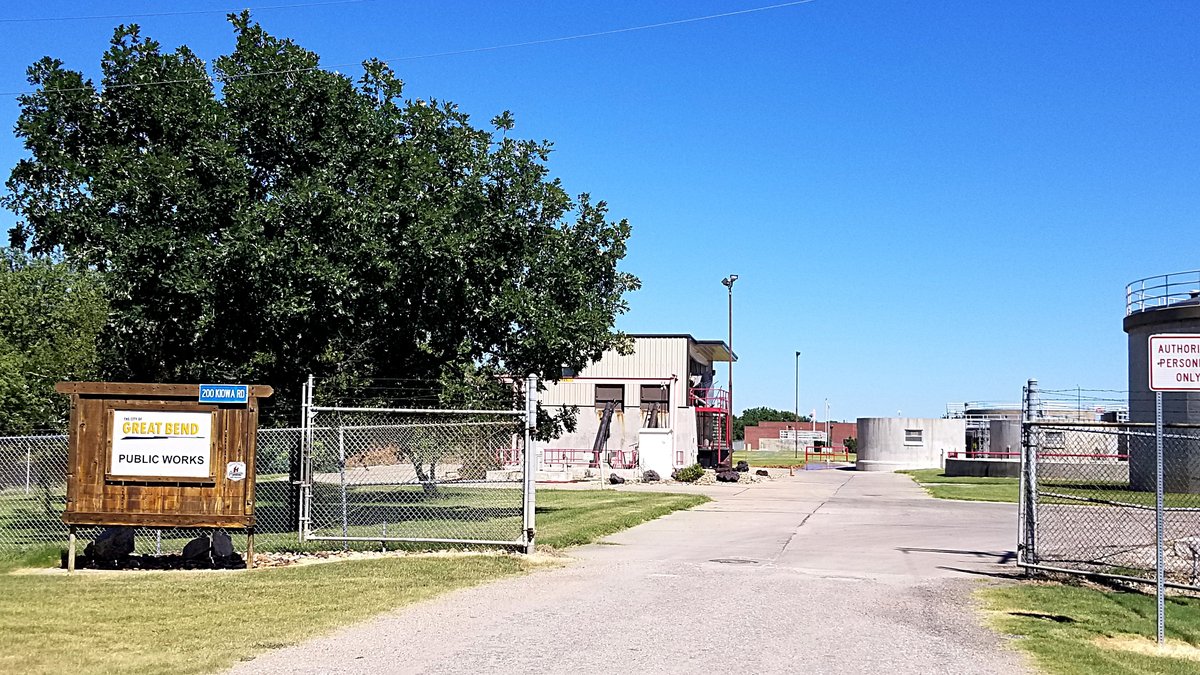
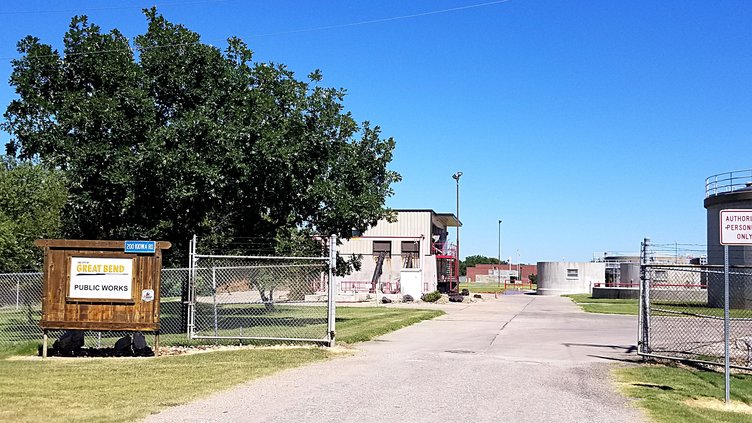
Great Bend’s wastewater treatment plant — built in 1954 with its last major upgrades completed in 1997 — is at the end of its service life. Nearly 100 miles of freshwater lines run beneath city streets, some dating to the early 1900s, with the city’s 10 wells constructed between 1937 and 1985 — well past the average 40-year life expectancy. Two wells have effectively been taken offline: one lost to nitrate contamination, another contaminated with PFAS and usable only in emergencies. Nitrate plumes are migrating eastward, threatening additional municipal wells. Burns said the city has identified an estimated $120 to $160 million in combined water and sewer infrastructure needs.
“We’re playing catch-up,” Burns said. “Water is going to be the biggest thing we have to tackle in the future.”
Without new funding, engineering studies suggest priority wastewater improvements alone could add more than $15 per month to each customer’s sewer bill if financed over 30 years. Mayor Alan Moeder put it plainly at a May work session: “If you have to charge all the citizens for just the sewage treatment plant replacement, it could run up to $300 a year.”
The quarter-cent sales tax earmarked for the wastewater treatment plant would support State Revolving Fund loan applications the city has already submitted for approximately $26 million in treatment plant improvements. If the STAR Bond project performs as projected and covers its own bond payment through operating revenue, the quarter cent intended for the STAR Bond can be redirected to water and sewer infrastructure as well — meaning visitors to the dragstrip and athletic complex would effectively be helping fund improvements that would otherwise fall entirely on local ratepayers.
“If we can keep the usage fees from going up — everybody helps pay for it and you’re not putting it back on your water bill,” Burns said.
What the County was asked
In his presentation to the Barton County Commissioners, Burns asked the County to consider contributing its portion of the sales tax increment generated within the STAR Bond district toward the project — similar to how the state waives its share of the increment above the baseline, allowing that new growth to repay STAR Bond investors rather than flowing to Topeka.
Financial advisors projected that county contribution at approximately $1.85 million over 10 years, or roughly $184,000 per year. Commissioners, however, pointed out that the projection was calculated using the full 1% county sales tax rate, without accounting for the fact that Great Bend already receives approximately 40% of that 1% through the normal distribution formula — meaning that portion is likely already reflected elsewhere in the city’s budget. Burns acknowledged the discrepancy and said he would be following up with financial counsel to verify the exact mechanics and establish a more precise figure.
The county has not yet formally committed to directing its share of the sales tax increment toward the project.
Timeline and next steps
The next major milestone for the STAR Bond project is a public hearing set for July 6, where the city’s bond counsel, Dominic Eck of Gilmore & Bell, and financial advisor David Arteberry of Stifel Nicolaus are both expected to present. Following the public hearing, the city council would need a two-thirds majority vote to formally adopt the project plan.
The project plan has already received approval from the Kansas Department of Commerce. Legislation that had been set to expire in June extended the STAR Bond program to 2031, removing what Burns called a source of anxiety for the project team. The planning commission found the project consistent with the city’s comprehensive plan, and the city council on May 18 adopted a resolution calling for the public hearing.
The city council has also moved to form a committee of four council members, the mayor, and city staff to educate and inform the community about the proposed sales tax ahead of the November vote.
No vote at the public hearing approving the STAR Bond project plan would be binding, Burns noted. The critical decision point is the November election on the three-quarter cent sales tax. If approved, the tax would push the city’s total local sales tax rate to 9.45% — still below rates in larger nearby cities officials note. Unlike many voter-approved sales taxes, the proposal carries no expiration date. If that passes, construction and permanent financing would follow, with the earliest possible revenue generation beginning in April of the following year given the required 90-day notice period for a new sales tax to take effect.
Burns said even if the project is approved at every step, construction on the dragstrip expansion and sports complex would realistically not begin until 2027, with completion expected no later than 2030.
Just the beginning
Burns has spent months making the case that this project is about more than a dragstrip or a sports complex — that it’s about setting Great Bend up for the next 30 years. Whether voters agree in November will determine whether that vision moves forward or stays on paper.
“This could be huge,” Burns said. “There have been opportunities in the past that we haven’t taken, and people still talk about those.”
The Tribune will continue coverage of the STAR Bond project leading up to the July 6 public hearing. Questions or comments can be directed to the newsroom.